
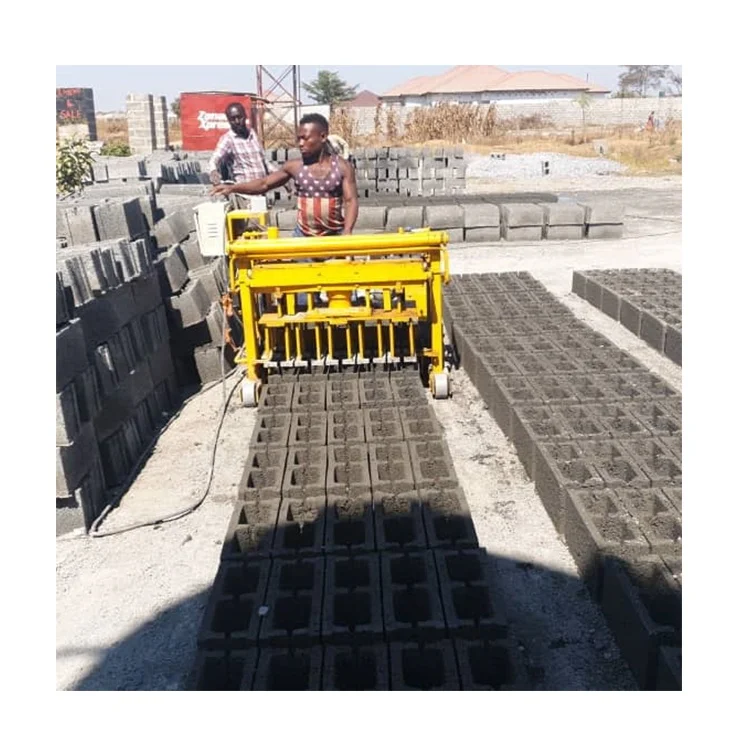
Mobile Block Machine Line Integration — We spec every station around the press to match its 30-second cycle, so material never waits and output never stalls.
Technical Specifications
| Parameter | Value |
|---|---|
| Model | QMY4-30 |
| Product Type | Mobile Concrete Block Making Machine |
| Rated Power | 5 kW |
| Molding Cycle Time | 30 seconds |
| Overall Dimensions | 1200 × 1200 × 1100 mm |
| Net Weight | 950 kg |
| Raw Materials | Cement, sand, crushed stones, slag |
| Output Capacity (Hollow 400×200×200 mm) | 480 pcs/hour (4 pcs/mold) |
| Output Capacity (Hollow 400×150×200 mm) | 600 pcs/hour (5 pcs/mold) |
| Output Capacity (Hollow 400×100×200 mm) | 840 pcs/hour (7 pcs/mold) |
| Daily Output (Hollow 400×200×200 mm) | 3,840 pcs/8 hours |
| Daily Output (Hollow 400×150×200 mm) | 4,800 pcs/8 hours |
| Daily Output (Hollow 400×100×200 mm) | 6,720 pcs/8 hours |
| Mould Format | Hollow block and solid brick (changeable moulds) |
| Automation Level | Manual operation (mobile, egg-laying type) |
| Voltage & Frequency | To be confirmed with buyer before production |
| Control System | To be confirmed with buyer before production |
| Hydraulic Pressure | To be confirmed with buyer before production |
| Vibration Force | To be confirmed with buyer before production |
Application Suitability
| Application | Material or Output |
|---|---|
| On-site block production without fixed plant | Hollow blocks from cement, sand, crushed stone at building sites |
| Small-scale hollow block manufacturing | 400×200×200 mm and 400×150×200 mm hollow blocks |
| Entrepreneur first block plant with low investment | Solid bricks and hollow blocks with changeable moulds |
| Contractor block production at project site | Local aggregate mixes including slag and crushed stone |
Why "3840 Pieces per Day" Misses Half the Picture
A press that cycles in 30 seconds will idle half the day if the mixer cannot keep up.
Quoted daily output for the QMY4-30 assumes a continuous 8-hour shift with material constantly available. In actual project-site conditions, mixing delays, pallet handling bottlenecks, and curing area congestion frequently cut real throughput well short of brochure figures. When I first visited a housing project in Ecuador, the contractor had purchased a mobile egg-laying press identical in class to this one but had no mixer sized to its tempo — the press stood idle two minutes out of every five, waiting for the next batch. The Mobile Block Machine production line supporting equipment is what bridges the gap between quoted capacity and what you actually produce.
Mapping the Line Stations Around the Press
Every supporting station must match the QMY4-30 molding time of 30 seconds to prevent the press from standing idle between cycles. Raw material feeding, mixing, and pallet supply are the upstream links — if any one of them runs slower than the press tempo, the entire Mobile Block Machine production line supporting equipment setup underperforms. The goal is to treat the line as a system rather than a standalone press with manual afterthoughts bolted on afterward.
Upstream Mixing and Material Consistency
Changeable moulds on this machine mean you will switch between hollow block and solid brick formats during a production run. Upstream mixing consistency must cover both formats without requiring a material changeover pause. If your mixer delivers a batch that is too wet for hollow block or too dry for solid brick, you lose time correcting the mix rather than producing. This is where line planning around the Mobile Block Machine production line supporting equipment pays off — matching mixer output rate and batch consistency to whatever format the press is running at that moment [NEED_CITE: batch consistency requirements for concrete block production across multiple formats].
Power, Footprint and On-Site Flexibility
The 5 kW rated power keeps utility demand low, simplifying generator sizing for remote project locations where grid connection is unreliable or unavailable. The 950 kg net weight and compact 1200 × 1200 mm footprint allow placement on unprepared ground — a practical advantage for contractors who need to produce directly at the building site without investing in concrete foundations. This also means the unit fits within standard container loading, reducing freight complications for buyers importing from overseas.
The Cost of Skipping Line-Level Planning
When the surrounding stations are not planned as a system, the press becomes the bottleneck by default. A mixer that is undersized relative to the 30-second molding cycle forces the operator to wait between batches, and the quoted daily output becomes unreachable regardless of how well the press itself performs. Pallet supply interruptions, curing rack shortages, and manual stacking delays compound the problem — the line stalls not because the press failed but because nothing was specified to support its tempo [NEED_CITE: production line bottleneck analysis in small-scale block manufacturing]. Contractors who discover these gaps after commissioning end up retrofitting stations piecemeal, which costs more and disrupts production longer than planning the full line upfront.
Why Source the Complete Line Here
Block machinery is our single focus, which means the QMY4-30 press, moulds, pallets, and handling stations are specified as one matched system rather than assembled from separate suppliers. We set configuration against the buyer’s actual mix design, local aggregate, and target block format instead of defaulting to a catalogue standard. Mould design covers the formats the buyer’s market actually sells, including custom drawings for non-standard sizes. Automation level is selectable — start with manual pallet handling on the QMY4-30 and add stacking or curing rack handling as a line upgrade when output grows. Installation and commissioning support includes operator training so the crew understands the relationship between mixing tempo and press cycle from day one.
Documentation & Verification
- Line layout drawing showing station connections and cycle time matching per block format
- Machine specification sheet covering press and all supporting equipment quoted
- Mould drawing and format list verified against your local market block sizes
- Voltage and control language confirmation document signed before production
- Factory test record on your specified raw material mix before dispatch
- Packing photographs and customs documentation support for import clearance
Installation, Commissioning & Support
- 5 kW power requirement allows standard site generator connection without dedicated transformer
- 1200 × 1200 mm footprint requires minimal ground preparation for initial placement
- Mobile egg-laying assembly arrives fully mounted with no fixed foundation needed
- On-site commissioning includes vibration and pressure adjustment to your local aggregate mix
- Operator training covers mould change procedure for both hollow block and solid brick formats
- Wear parts and mould replacement list provided for first reorder planning
Preparing Your Inquiry
To size the line correctly, provide your target block format, daily output requirement, and the raw materials available locally including aggregate type and moisture content. Confirm your site voltage, frequency, and preferred control language so commissioning proceeds without delay. If you have existing mixers, pallets, or curing racks, share their specifications so the supporting equipment can be matched to what you already have on site.
Frequently Asked Questions
Q: How do I match the mixing station output to the QMY4-30 cycle time so the press never waits for material?
A: The QMY4-30 completes a mold every 30 seconds, so your mixer must deliver a fresh batch at that same interval. We calculate mixer batch size and cycle time against the block format you are running and specify a mixer that keeps the press continuously fed without overproducing material that sets before use.
Q: What pallet size and curing area layout should I plan for, and does this mobile machine need pallets at all?
A: The QMY4-30 is an egg-laying type that deposits blocks directly onto the ground, so production pallets are not required during pressing. However, you still need a curing area plan — we lay out rack spacing and handling routes based on your daily output per format so blocks are moved and stacked without congestion.
Q: Can I start with the QMY4-30 standalone and add automatic stacking or curing rack handling later?
A: Yes. The mobile configuration is designed for manual operation initially, and supporting stations such as pallet handling, stacking, and curing rack systems can be added as line upgrades. We plan the line layout from the start with future station connections in mind so retrofits do not require repositioning the press.
Q: What voltage and frequency confirmation do I need before shipment to avoid delays on site?
A: We require written confirmation of your site voltage, frequency, and preferred PLC display language before the QMY4-30 enters production. Without this, the electrical system may not match local supply or the operator may not be able to read the control interface, delaying commissioning after arrival.
Q: How is daily output calculated across different block formats, and what does the 8-hour figure assume?
A: Daily output figures assume an 8-hour continuous shift with no mixing delays, mould changes, or pallet interruptions. The QMY4-30 produces 3,840 pieces per 8 hours on 400×200×200 mm hollow blocks, 4,800 on 400×150×200 mm, and 6,720 on 400×100×200 mm — each based on its respective mold cavity count.


