
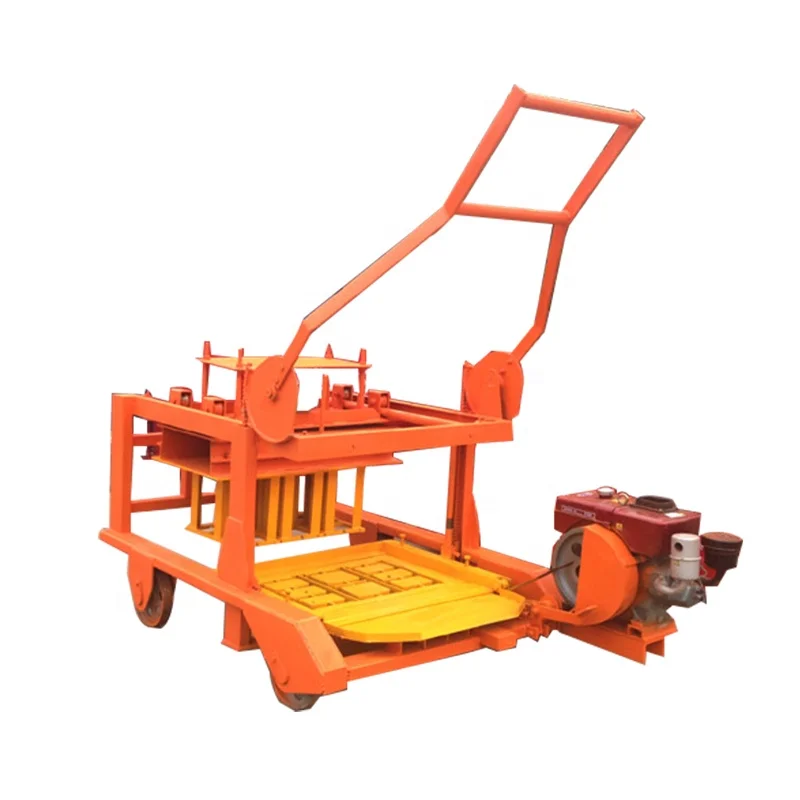
Line-Matched Configuration — every station from raw material mixer through curing rack is sized to the 30-second press rhythm so the QMR4-45 is never starved or bottlenecked on a remote site.
Technical Specifications
| Parameter | Value |
|---|---|
| Model | QMR4-45 |
| Product Type | Diesel Engine Mobile Concrete Block Making Machine |
| Total Power Source | Diesel engine |
| Hydraulic Method | Mold Vibration |
| Exciting Power | 28.6 KN |
| Excitation Frequency | 4500 r/min |
| Molding Cycle | 30 s |
| Output Capacity | 3000 pcs/day (8 hours) (basis not stated in source — confirm block format / material / thickness) |
| Overall Dimensions (L×W×H) | 1300 × 1500 × 1000 mm |
| Net Weight | 950–1000 kg |
| Assembly State | Mobile, wheel-mounted |
| Control System | Manual handle operation |
| Automation Level | Manual / semi-manual with hydraulic assist |
| Mould Format | Custom mould design available to buyer drawings |
Application Suitability
| Application | Material or Output |
|---|---|
| On-site hollow and solid block production for building contractors | Concrete, sand, cement, stone dust, river sand |
| Remote housing project block manufacturing | Fly ash, lime, gypsum, construction waste, slag |
| Temporary block yard near development sites | Mine tailings, coal gangue, porcelain granule, sandrock |
| Off-grid block production where electrical supply is unavailable | Diesel-powered operation across mountainous, desert, and coastal terrain |
Why "3000 Pieces per Day" Means Nothing Without the Rest of the Line
A mobile press is only as fast as the slowest station feeding it or clearing behind it.
I have seen contractors pull a mobile block machine onto a site in West Africa, fire it up, and then watch it sit idle half the shift because the mixer batch size was wrong or nobody specified how pallets would move. The QMR4-45 cycles every 30 seconds, which sounds productive until you calculate that the upstream mixer must deliver a consistent batch at that same interval and the downstream pallet handling must keep pace. When any one station in a mobile block machine production line supporting equipment setup falls out of sync, the rated output collapses. [NEED_CITE: production line synchronization principles for concrete block manufacturing]
Upstream Mixing Must Match the 30-Second Press Rhythm
The QMR4-45 demands a fresh concrete batch every half minute. If the mixer is undersized, the press waits. If the mixer delivers too much at once, the mix begins to set before it reaches the mould. Sizing the mixer drum volume and discharge rate to the press cycle is the first step in building a functional mobile block machine production line supporting equipment arrangement. Getting this wrong on a remote site means wasted cement and inconsistent block density.
Downstream Pallet Flow and Curing Rack Capacity
Every 30 seconds a loaded pallet exits the press. Over an eight-hour shift that adds up to nearly a thousand pallets moving through the curing area. The pallet size and material must be confirmed against the buyer’s existing forklift and curing space before the line is finalized. When pallet specification is left as an afterthought, blocks get stacked by hand on uneven ground and strength suffers. [NEED_CITE: pallet handling and curing rack layout for mobile block production]
Diesel Power Across Every Station
The QMR4-45 runs on a diesel engine, which makes sense for off-grid project sites in regions like Congo and Ghana where electrical infrastructure may not reach the build location. But the mixer and any auxiliary conveyors in the mobile block machine production line supporting equipment layout must also be diesel-compatible or the entire off-grid advantage disappears. Specifying every motor and drive for the same fuel source keeps the line self-sufficient.
What 28.6 KN Exciting Power Actually Does to Block Density
Vibration force and excitation frequency together determine how tightly aggregate particles pack inside the mould cavity. The 28.6 KN exciting power at 4500 r/min is calibrated for mold vibration rather than table vibration, meaning the force acts directly on the mould walls. This method works well with a range of raw materials — from river sand and cement to fly ash and construction waste — but the mix moisture content must be matched to the vibration profile. Too wet and the block slumps after demoulding; too dry and voids remain. The mixer output consistency is therefore not a separate concern but a direct input to the press result. Pallet dimensions of the line must also align with the curing rack spacing, because a mismatch forces manual re-stacking and introduces handling damage before the block has gained initial set strength.
The Hidden Cost of Quoting the Press Alone
When a quotation covers only the press, the buyer discovers on arrival that pallet feeding, raw material batching, and curing rack handling were never included. Contractors then improvise with wheelbarrows and timber planks, and the mobile block machine production line supporting equipment configuration that should have been engineered at the factory becomes a patchwork on site. Block strength varies, output drops, and the daily capacity figure quoted at purchase becomes irrelevant. [NEED_CITE: common omissions in mobile block machine quotations]
Why Buyers Source the Full Line Here
Block machinery is our single focus, which means the QMR4-45 press, its mould, pallets, and every handling station are specified as one matched system rather than assembled from separate suppliers. We configure the line against the buyer’s actual mix design and local aggregate, not a catalogue default. Mould design is available to buyer drawings, so the block format matches the market the buyer sells into. Automation level is selectable, allowing a contractor to start with manual pallet handling and add stations later. Installation and commissioning support includes operator training on site so the crew understands the 30-second cycle rhythm from day one.
Documentation & Verification
- Line layout and capacity calculation stating the block format assumed for the QMR4-45 output figure
- Machine specification sheet covering diesel engine rating, exciting power, and mould vibration method
- Mould drawing and format list matching the buyer’s target block dimensions
- Pallet specification confirming size and material against the buyer’s curing area and forklift
- Factory test record run on the buyer’s specified raw material mix before dispatch
- Operation and maintenance manual with daily greasing points and wear part replacement intervals
Installation, Commissioning & Support
- Level compacted ground with no fixed foundation required, matching the wheel-mounted 1300 × 1500 × 1000 mm footprint
- Diesel fuel supply confirmed for press and mixer, eliminating electrical wiring on site
- Machine arrives assembled on wheels; roller into position and connect mixer discharge chute
- First-run block samples tested for density and dimensional tolerance against the buyer’s standard
- Operator training covers 30-second cycle pacing, mould change procedure, and mix moisture adjustment
- Wear parts list provided with mould liner and vibration spring replacement intervals
Before You Request a Quote
Tell us the exact block format you intend to produce, the daily volume your project requires, and the raw materials available at your site. Confirm whether diesel power is needed for all stations or whether partial electrical supply exists. Let us know your available curing area dimensions and any forklift or pallet rack you already own so the mobile block machine production line supporting equipment layout fits your ground conditions.
Frequently Asked Questions
Q: How is the 3000 pieces per day capacity verified, and which block format does it assume?
A: That figure is based on an eight-hour shift at the 30-second cycle, but the source does not state which block format or material thickness it assumes. Before we confirm a capacity number for your project, we calculate output against your specific block dimensions and mix design so the daily figure reflects what you will actually produce on site.
Q: How do the mixer batch cycle and pallet feeding pace match the 30-second press cycle?
A: We size the mixer drum so each batch discharges within the 30-second window, preventing the press from waiting or the mix from setting prematurely. Pallet feeding is arranged so a fresh pallet is positioned before each cycle completes, keeping the rhythm continuous across an eight-hour shift.
Q: What pallet size and material are required, and how do they connect to the curing rack layout?
A: Pallet dimensions and material are selected to match your existing curing area spacing and forklift capacity. We confirm these details before finalizing the quotation so pallets move smoothly from press to curing rack without manual re-stacking or handling damage during the initial set period.
Q: Can the line operate entirely on diesel power without site electrical supply?
A: Yes. The QMR4-45 press runs on a diesel engine, and we configure the mixer and any auxiliary conveyors in the mobile block machine production line supporting equipment setup for diesel drive as well, so the entire line functions independently of the electrical grid.
Q: Which stations are included in the quotation and which are assumed to be handled manually?
A: Our quotation lists every station from raw material feeding through curing rack handling. If any step is designated for manual operation, we state it explicitly so you know exactly where labour is required and where mechanical handling is already accounted for in the line layout.


