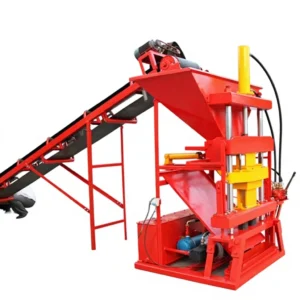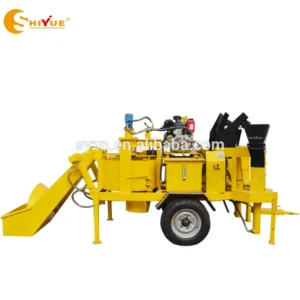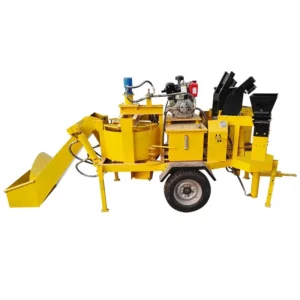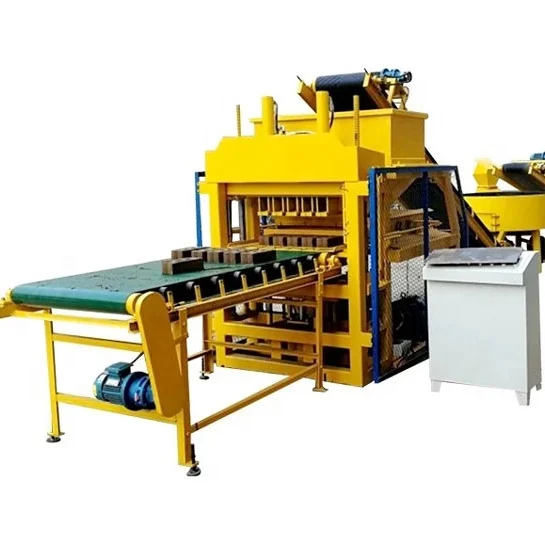
Matched Line Integration — The LY5-10 is positioned at the center of a coordinated clay interlocking brick production sequence where crusher, mixer, and conveyor cycle times are verified against the 10-second press cycle so material flow never stalls.
Technical Specifications
| Parameter | Value |
|---|---|
| Model | LY5-10 Clay Brick Machine with PLC |
| Product Type | Automatic Interlocking Clay Brick Making Machine |
| Overall Dimensions (L×W×H) | 2260 × 1500 × 2380 mm |
| Net Weight | 2200 kg |
| Rated Power | 15 kW |
| Control System | PLC controlled |
| Molding Cycle | 10 s |
| Output Capacity | 14400 pcs/day (basis not stated in source — confirm block format / material / thickness) |
| Bricks per Cycle | 1 or 2 (according to the mold) |
| Raw Material | Clay, soil, cement or other construction dregs |
| Brick Height Adjustment | Adjustable via screws |
| Hydraulic System | Yes, 70 L anti-wear hydraulic oil capacity |
| Gearbox Oil Capacity | 15 kg |
| Related Equipment | JQ500 Concrete Mixer, 6M Conveyor Belt, Soil Crusher, Soil Screening Machine, 4m Belt Conveyor, Output Conveyor |
| Mould Change | Supported, mould interchangeable per customer requirements |
| Voltage & Frequency | Configurable to buyer market (to be confirmed) |
| PLC Display Language | Configurable to buyer market (to be confirmed) |
| Automation Level | Automatic, single-person operation of the pressing cycle |
Application Suitability
| Application | Material or Output |
|---|---|
| Housing project on-site brick production | Local clay and soil blended with cement |
| Building material supply yard | Interlocking clay bricks from screened soil and construction dregs |
| Community-scale construction supply | Solid and interlocking formats from clay-cement mixes |
| Development site material self-sufficiency | Crusher-fed soil and cement blends through the JQ500 mixer |
What "14,400 Bricks per Day" Leaves Out About Your Line
A daily output figure means nothing unless it names the brick format, wall thickness, and material blend it assumes.
When a quotation quotes a capacity number without specifying the interlocking format behind it, buyers frequently discover on commissioning day that their actual production falls well short of plan. The press may complete a cycle every 10 seconds, but if the soil crusher upstream takes longer to process raw clay than the press takes to consume it, the machine sits idle between cycles. That idle time compounds across a shift. I have seen lines where the mixer discharge interval was simply never checked against the press feed rate, and the result was a brick press running at a fraction of its potential for months before anyone investigated [NEED_CITE: common causes of throughput shortfall in brick production lines]. The interlocking clay brick machine production line must be specified station by station, not quoted as a single headline number.
How Upstream Stations Govern Press Uptime
The soil crusher and screening machine sit at the very beginning of this line, and their throughput sets the ceiling for everything downstream. If the crusher cannot reduce raw clay to a consistent particle size fast enough, the JQ500 mixer receives uneven feed, which in turn delivers an inconsistent blend to the LY5-10 hopper. The PLC controls the pressing cycle itself with precision, but it cannot compensate for material that arrives late or out of specification. Every conveyor length — the 6-meter belt from the mixer, the 4-meter belt feeding the press, and the output conveyor carrying finished bricks away — must be timed so that no station waits on another.
Where the Line Ends and Your Site Begins
This interlocking clay brick machine production line scope includes raw material preparation, mixing, pressing, and output conveying. What it does not include is the curing area, pallet inventory, or stacking labour downstream of the output conveyor. Buyers sometimes assume these are part of the quotation because they appear in the supplier’s brochure photographs. Clarifying the line boundary before purchase prevents the situation where finished bricks pile up on the output belt because no curing racks are ready to receive them [NEED_CITE: scope gap between brick press quotation and site readiness]. The turnkey question is always: where does the supplied equipment stop, and what must the buyer already have in place?
Reading the Specifications Against Your Actual Product
The 15 kW rated power must be read alongside the hydraulic system’s 70-litre oil capacity. Hydraulic pressure is what compresses the clay-cement blend into a dense interlocking brick, and oil volume determines how long the system can sustain peak pressure before thermal buildup forces a cooldown interval. In a continuous production shift, a hydraulic reservoir that is undersized for the ambient temperature will see oil viscosity drop, reducing effective pressing force and producing bricks with lower compressive strength toward the end of the day. The adjustable brick height via screws allows format changes, but each height setting alters the volume of material per cycle, which shifts the actual daily count away from any single headline figure. The PLC-controlled single-person operation reduces labour at the press, yet the upstream crusher and screening stations still require attendants — so total line staffing depends on the degree of material handling automation the buyer adds beyond this base scope.
The Cost of Skipping the Line-Level Audit
When upstream and downstream stations are sourced separately or specified without cycle-time alignment, the most expensive component — the brick press — becomes the bottleneck by default. A mixer that discharges 40 seconds slower than the press feed interval does not just reduce output; it forces the hydraulic system through repeated start-stop cycles that accelerate seal and valve wear. Buyers who discover this mismatch after installation face a choice between replacing upstream equipment at their own cost or accepting permanently reduced throughput. The electrical load of adding a larger mixer or an extra conveyor after the fact may also exceed the originally planned site power supply, triggering rewiring expenses that were never in the project budget [NEED_CITE: hidden costs of unmatched station cycle times in block plants].
Why This Line Is Specified as a System
Block machinery is the single focus here, which means the LY5-10 press, JQ500 mixer, soil crusher, screening machine, and every conveyor are specified as one matched set rather than assembled from unrelated suppliers. The configuration is built around the buyer’s actual clay source and target brick format, not pulled from a catalogue default. Mould design covers the interlocking profiles the buyer’s local market actually sells, and custom mould drawings are available when standard profiles do not match. Automation level is selectable, so a buyer can commission the line semi-automatic and add automatic pallet feeding or stacking later without replacing the press. Installation support includes operator training on the full line, not just the press in isolation.
Documentation & Verification
- Line layout drawing with capacity calculation stating the exact interlocking brick format assumed
- Machine specification sheet confirming LY5-10 dimensions, power rating, and hydraulic oil capacity
- Mould drawing and format list showing every interlocking profile available for this press
- Hydraulic and electrical schematic detailing the 70-litre system and PLC wiring
- Voltage, frequency, and PLC display language confirmation recorded before production begins
- Factory test record demonstrating press cycle and related equipment operation before dispatch
Installation, Commissioning & Support
- Foundation pad sized to the 2260 × 1500 mm footprint with anchor bolt plan provided
- Dedicated power circuit sized for the 15 kW rated load plus upstream equipment draw
- Machine ships partially disassembled; on-site assembly includes hydraulic line connection and oil fill
- PLC parameters set during commissioning to match the buyer’s confirmed brick height and cycle timing
- Operator training covers the full sequence from soil crusher start-up through output conveyor handling
- Wear parts list identifies mould liners, hydraulic seals, and conveyor belt splicing intervals
What We Need to Scope Your Line Accurately
To build a reliable capacity calculation, share the interlocking brick format and wall thickness your market demands, along with a sample or description of the local clay or soil you plan to use. Confirm the site voltage and frequency, the PLC display language your operators require, and the curing space you already have available. If you are integrating this line with existing conveyors or mixers, provide their model and cycle times so we can check alignment before quotation.
Frequently Asked Questions
Q: How is the 14,400 pcs/day output calculated, and which interlocking brick format does it assume?
A: That figure appears in the source data without a stated brick format, material blend, or thickness. Before treating it as a firm commitment, request a capacity calculation that names the exact interlocking profile, wall thickness, and clay-cement ratio used to derive it. Without those details, daily output on your actual product may differ substantially.
Q: Do the upstream stations match the 10-second press cycle so the press is never left waiting?
A: The JQ500 mixer, soil crusher, screening machine, and conveyors are specified together with the LY5-10, but cycle-time alignment must be confirmed for your specific material. Dense or sticky clay may slow the crusher or mixer discharge, so verifying each station’s interval against the 10-second press cycle during the proposal stage prevents idle time on commissioning day.
Q: What is included in the line scope versus what the buyer must source locally?
A: The supplied scope covers the soil crusher, screening machine, JQ500 mixer, conveyors, the LY5-10 press, and the output conveyor. Curing area, pallets, stacking labour, and forklift handling downstream of the output conveyor are not included. Confirm these site-side requirements before the line arrives to avoid production delays.
Q: How are voltage, frequency, and PLC language confirmed before shipment?
A: These parameters are configurable and must be agreed during the quotation stage. Provide your local supply voltage, frequency, and the language your operators read. The PLC display language and electrical components are then locked into the production order so the machine arrives ready to connect without on-site modification.
Q: What is the mould change procedure and how many interlocking formats can the LY5-10 accommodate?
A: The LY5-10 supports mould changes to produce different interlocking brick profiles, with brick height adjustable via screws. The number of formats depends on which moulds are ordered. Custom mould drawings are available, so discuss the profiles your local construction market requires and request a format list with changeover time estimates.