Line-Level Throughput — the LY2-40 press sets a 30–40s cycle tempo, so the mixer, feed path, and curing layout must be specified as one matched system rather than sourced separately.
Technical Specifications
| Parameter | Value |
|---|---|
| Model | LY2-40 |
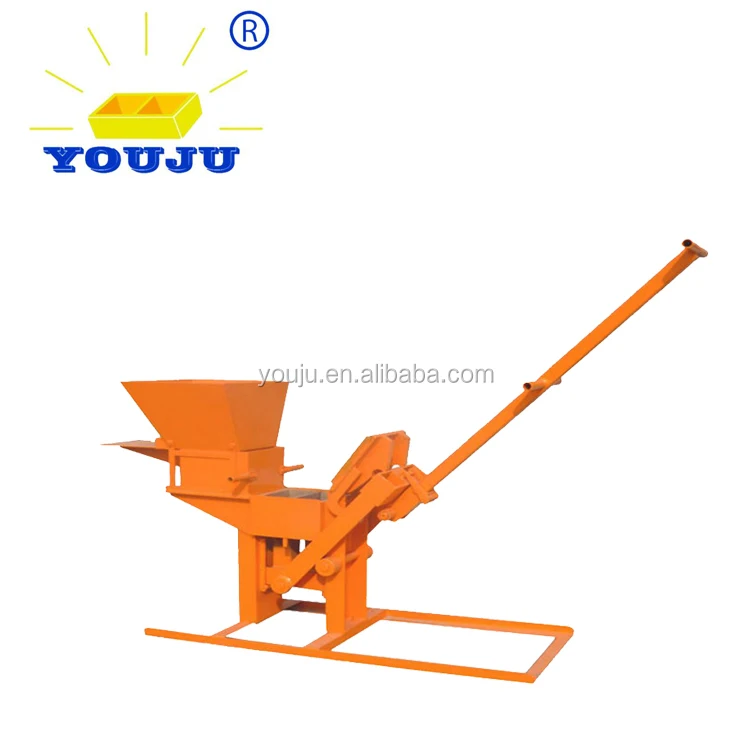
| Product Type | Manual Clay Interlocking Brick Making Machine |
| Total Power | No power — fully manual operation, no electrical or hydraulic source |
| Overall Dimensions (L×W×H) | 1600 × 700 × 1200 mm |
| Net Weight | 200–240 kg |
| Mould Format | Interlocking earth block, moulds changeable |
| Molding Cycle | 30–40 seconds (basis not stated in source — confirm block format and material) |
| Output Capacity | 400–1000 pcs/day (basis not stated in source — confirm block format and material) |
| Lifting System | Manual |
| Mobility | Steel wheels for on-site repositioning |
| Recommended Mixer | JFA-1 Mixer or JQ350 Mixer (sold separately) |
| Automation Level | Fully manual — no motorized lifting, feeding, or stacking |
| Control System | None |
| Voltage & Frequency | Not applicable |
| Hydraulic Pressure | Not applicable |
| Vibration Force | Not applicable |
| Pallet Size | Not applicable — blocks formed directly on ground |
| Warranty | 1 Year |
Application Suitability
| Application | Material or Output |
|---|---|
| Off-grid construction sites with no electrical supply | Soil-cement mix, compressed earth interlocking bricks |
| Rural housing and community building projects | Local soil blended with cement, formed into interlocking format |
| Mobile on-site production for housing project contractors | Earth blocks produced at the building location, press relocated as work progresses |
| Small-scale producers transitioning from hand-moulding | Mechanised pressing of soil-cement blocks with manual mixer feed |
Why the Mixer Matters More Than the Press on a No-Power Line
A manual press only produces as fast as the wet mix arrives at the hopper.
When buyers size a manual clay interlocking brick machine production line supporting equipment package, the brochure cycle of 30–40 seconds looks achievable. In practice, hand-mixing soil-cement in a wheelbarrow cannot sustain that tempo — the operator finishes one batch, walks to the press, shovels the mix in, and waits for the next batch to cure enough to handle. The real daily count falls well short of the quoted range because the mixer output and the press cycle were never matched as one system [NEED_CITE: typical manual block line throughput losses from uncoordinated station pacing].
Matching Mixer Batch Size to the 30–40 Second Press Cycle
The LY2-40 completes one interlocking block every 30–40 seconds, which defines the maximum tempo the entire line must sustain. A JFA-1 or JQ350 mixer must discharge a batch volume that covers roughly two to three press cycles before the next batch is ready. If the mixer takes longer to complete a batch than the press takes to consume one, the operator stands idle and the manual clay interlocking brick machine production line supporting equipment arrangement fails its purpose.
Planning the Curing Area Around a Mobile Press
Steel wheels let the LY2-40 move across the site as the building rises, but the curing area and block-carrying distance must be re-planned every time the press shifts. Green interlocking blocks formed directly on the ground need a flat, shaded curing zone within a short carry distance. If the curing zone is too far, workers spend more time transporting wet blocks than pressing them, and the line output drops accordingly [NEED_CITE: on-site compressed earth block curing distance and labour allocation studies].
Reading the Specs That Actually Govern Daily Output
The absence of hydraulic pressure and vibration force on this machine means block density depends entirely on the operator’s physical leverage and the soil-cement mix consistency. A drier mix compresses faster but may crack during curing; a wetter mix holds shape better but extends the demoulding time beyond the stated 30–40 seconds. The mould format determines the volume of mix per cycle — a larger interlocking block consumes more material per press, which in turn demands a higher mixer discharge rate to keep pace. Net weight of 200–240 kg keeps the unit portable by hand across firm ground, but soft or sloping sites may require a levelled gravel pad to prevent the frame from tilting during compression.
The Hidden Cost of Treating the Press as a Standalone Purchase
Buyers who order the LY2-40 without specifying the mixer, feed path, and curing layout as one package often discover that the bottleneck simply moves to whichever station was left unplanned. The press sits idle while a hand-mixed batch catches up, or green blocks pile up beside the mould because no curing rack area was prepared. These gaps do not show up in a single-machine quotation but become obvious on the first production day [NEED_CITE: common manual block plant commissioning delays from incomplete line specification].
Why Line-Level Specification Matters Here
Every supporting station — mixer, material feed, curing layout — is specified against the LY2-40 cycle time, not pulled from a generic catalogue. Soil-cement mix ratios are confirmed against the buyer’s local aggregate before the line ships, so the first test run uses material the buyer can actually source. The mobility of the press is factored into the curing area plan, so block-carrying distances stay short as the press relocates. Labour allocation across mixing, pressing, and stacking is calculated as one system, matching the manual clay interlocking brick machine production line supporting equipment scope. Documentation includes a line layout drawing with daily capacity stated per block format, not a single unqualified number.
Documentation & Verification
- Line layout drawing showing mixer placement, feed path, press position, and curing zone with capacity stated per interlocking block format
- Mixer specification sheet matched to the LY2-40 cycle, listing batch volume and discharge rate
- Soil-cement mix ratio confirmation against buyer’s local soil sample before shipment
- Factory test record showing press cycle timing with the recommended JFA-1 or JQ350 mixer
- Packing photographs of press and mixer loaded for container or break-bulk dispatch
- Operation manual covering mould change procedure and lever-arm maintenance intervals
Installation, Commissioning & Support
- Levelled gravel pad required for the 1600 × 700 mm frame footprint to prevent tilting during manual compression
- No electrical connection needed — the LY2-40 operates entirely without power, but the JQ350 mixer requires a dedicated circuit if used
- Steel-wheel mobility allows on-site repositioning; first placement should be within short carry distance of the curing zone
- Commissioning includes soil-cement mix trial with local aggregate to confirm block strength before full production begins
- Operator training covers lever-arm technique, mould release timing, and daily greasing points on the manual lifting system
- Wear parts list identifies replaceable mould liners and lever pivot pins with reorder codes
What to Include in Your Inquiry
Share the interlocking block dimensions you need, the soil type available on your site, and whether you already have a mixer or need one included. Confirm the daily block count your project requires and the curing space you can allocate beside the press. This lets us size the manual clay interlocking brick machine production line supporting equipment package so every station keeps pace with the LY2-40 cycle.
Frequently Asked Questions
Q: What mixer batch size keeps the LY2-40 running without idle gaps?
A: The JFA-1 or JQ350 mixer should discharge enough soil-cement mix to cover two to three 30–40 second press cycles before the next batch is ready. We confirm the exact batch volume against your block dimensions during line configuration so the press never waits on the mixer.
Q: How should the curing area be laid out around a mobile manual press?
A: Plan a flat, shaded curing zone within a short carry distance of the LY2-40, and re-position this zone each time the press moves on its steel wheels. Green interlocking blocks are formed on the ground, so the curing area must be level and protected from rain.
Q: Which soil types and cement ratios work with this press and its mixers?
A: We confirm the soil-cement ratio against a sample of your local soil before shipment. Laterite, sandy loam, and clay-loam soils have all been used with the LY2-40, but the exact cement percentage depends on the target block strength and the soil’s plasticity index.
Q: How do we calculate real daily output when every station is manual?
A: Real output depends on how many workers are allocated to mixing, pressing, and carrying. We provide a line-level capacity calculation that states daily output per block format, factoring in mixer batch time, press cycle, and curing carry distance, so the number reflects your actual labour arrangement.