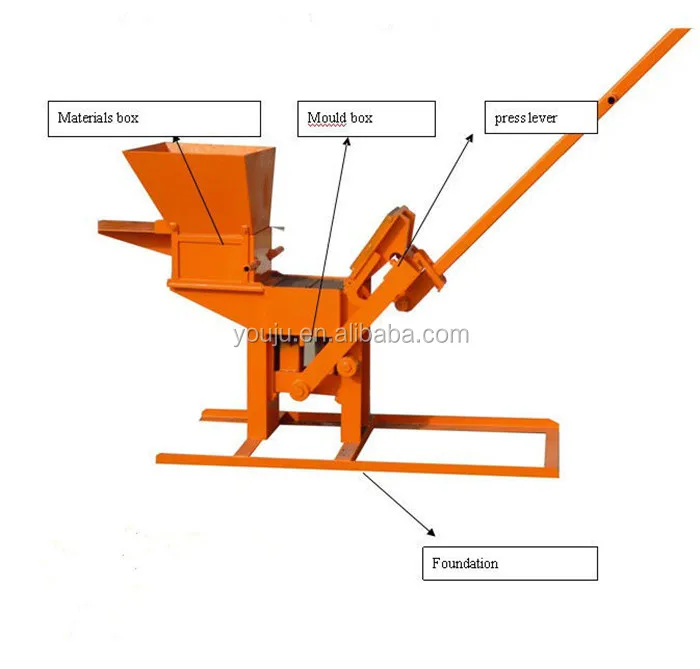
System-Synced Manual Pressing — The LY2-40 manual clay interlocking brick making machine production line integrates mixer cycle, pressing cadence, and curing logistics into one verified material flow rather than isolated standalone units.
Technical Specifications
| Parameter | Value |
|---|---|
| Model | LY2-40 |
| Product Type | Manual Clay Interlocking Brick Making Machine |
| Overall Dimensions (L×W×H) | 1600 x 700 x 1200 mm |
| Net Weight | 200-240 kgs |
| Rated Power | No Power, Completely Manual |
| Molding Cycle | 30-40s |
| Output Capacity | 400 pcs–1000 pcs/day (basis not stated in source — confirm block format / material / thickness) |
| Automation Level | Completely Manual |
| Mobility | Steel wheels for on-site movement |
| Recommended Mixer | JFA-1 Mixer or JQ350 Mixer |
| Warranty | 1 Year |
Application Suitability
| Application | Material or Output |
|---|---|
| Off-grid interlocking earth brick production | Locally sourced soil mixed with cement stabilizer |
| Small-scale housing and community construction | On-site clay brick pressing following daily wall-building pace |
| Mobile block production for contractors | Moving between job sites using steel-wheel mobility |
What "Up to 1000 Pieces a Day" Leaves Out About Manual Lines
A manual press is only as fast as the mixer feeding it and the curing space receiving its output.
When the LY2-40 is quoted as a standalone unit, the daily output figure often assumes an ideal material flow that rarely exists on a real job site. I have seen workers standing idle next to a manual press because the upstream mixer was still turning a batch, or because cured bricks had nowhere to go and the pressing station was blocked by wet output. The clay interlocking brick making machine production line only delivers its stated capacity when every station — mixing, pressing, curing, handling — is timed as one continuous rhythm [NEED_CITE: line balancing principles for manual block production].
Mixer-to-Press Timing That Prevents Idle Cycles
The LY2-40 completes one molding cycle every 30 to 40 seconds. For a clay interlocking brick making machine production line to sustain that cadence, the recommended JFA-1 or JQ350 mixer must discharge a fresh batch into the feed hopper before the press operator finishes the current cycle. If the mixer batch time exceeds the press cycle, the operator waits — and daily output drops well below the stated range.
Curing Space and Handling as Part of the Line Design
Every brick the LY2-40 produces needs a flat, level surface to cure without deformation. At higher output volumes, the curing area must be sized to hold multiple days of production simultaneously, since interlocking earth bricks typically require several days of moisture-controlled curing before they can be moved or stacked. Planning the curing footprint is part of the line, not an afterthought once bricks are piling up on the ground [NEED_CITE: curing requirements for cement-stabilized earth bricks].
Reading the Numbers That Actually Matter
The 200–240 kg net weight keeps the LY2-40 mobile on its steel wheels while providing enough mass to resist shifting during the manual pressing stroke. The 1600 x 700 x 1200 mm footprint means the press can operate in tight site conditions, but it also defines the minimum clearance needed between the mixer discharge point and the curing area. Since no electrical power is required for pressing, the only utility consideration for the full line is the mixer motor — and that voltage and frequency must match local supply before the line is commissioned. The completely manual operation removes power dependency from the most critical station, simplifying the entire production setup in areas where grid reliability is uncertain.
When the Line Breaks Down at the Weakest Station
A mismatched mixer is the most common hidden cost in a manual clay interlocking brick making machine production line. If the mixer is undersized, the press sits idle and workers are paid to wait. If the curing area is too small, freshly pressed bricks get stacked too early and crack under their own weight, creating waste that never reaches the wall. I have watched a contractor in the Middle East lose nearly an entire day of output because the material handling between press and curing area was never planned — bricks were carried by hand, one at a time, across an unprepared surface [NEED_CITE: material handling losses in manual brick production].
Why Sourcing the Line Together Matters
The LY2-40 is configured against the buyer’s actual soil type and cement ratio, not a catalogue default, so the mixer recommendation matches local material behavior. Mould design covers the interlocking formats the local construction market actually uses, including custom drawings when standard profiles do not fit the project specification. The entire line — press, mixer, pallet specification, curing rack layout — is documented as one system, so capacity calculations state the exact block format and mix ratio assumed. Automation level is selectable at the line level, allowing a buyer to start fully manual and add mechanized mixing or pallet handling later without replacing the press. Installation support covers line layout and station spacing, not just individual machine placement.
Documentation & Verification
- Line layout drawing showing mixer, LY2-40 press, and curing area spacing
- Capacity calculation stating the block format and soil-cement ratio assumed
- Mixer specification sheet matched to 30–40s press cycle timing
- Factory test record on buyer’s target interlocking brick profile before dispatch
- Operation manual covering full line workflow from mixing through curing
Installation, Commissioning & Support
- Level compacted ground required across the 1600 x 700 mm press footprint and mixer station
- Mixer motor voltage and frequency confirmed before line commissioning on site
- Steel-wheel press positioned after mixer discharge alignment is verified
- First-run test with buyer’s local soil and cement ratio to calibrate mix moisture
- Operator training on cycle timing between JFA-1 mixer batches and press strokes
- Wear parts list for manual press components and mould surfaces provided at delivery
What We Need to Configure Your Line
To specify the clay interlocking brick making machine production line around your actual site conditions, we need the interlocking brick format and dimensions your local market requires, the type of soil available and its clay content, and your target daily output so we can size the mixer and curing area accordingly. If the mixer motor will run on local grid power, please confirm the voltage and frequency at your project location.
Frequently Asked Questions
Q: How is the 400–1000 pcs/day capacity verified for the LY2-40 line?
A: The stated range is published without a confirmed block format or mix ratio. Before quotation, we calculate realistic daily output based on the specific interlocking brick dimensions, soil-cement ratio, and mixer batch cycle you will use on site, so the figure reflects your actual conditions rather than a generic assumption.
Q: How must the mixer batch cycle match the LY2-40 press timing?
A: The LY2-40 completes a molding cycle every 30–40 seconds. The recommended JFA-1 or JQ350 mixer must discharge a full batch within that window to prevent operator idle time. We confirm mixer batch size and mixing duration against your target output before the line is finalized.
Q: What curing space and handling equipment does the line require?
A: Curing area must hold several days of pressed bricks on flat, level surfaces without stacking. We calculate the required footprint based on your confirmed daily output and brick dimensions, and specify pallet type or ground preparation so bricks cure without deformation or cracking.
Q: Can the line work with different local soil types?
A: Yes. The soil-cement mix ratio and moisture content must be adjusted to match the clay content and grain structure of locally available soil. We run a first-production test during commissioning using your actual material to confirm block strength and adjust the mix before full output begins.