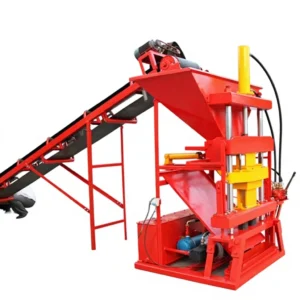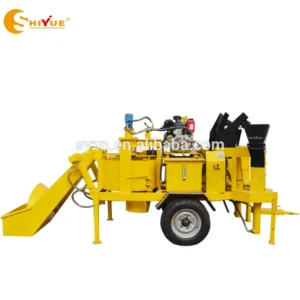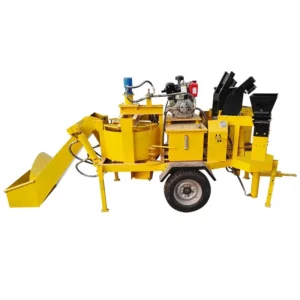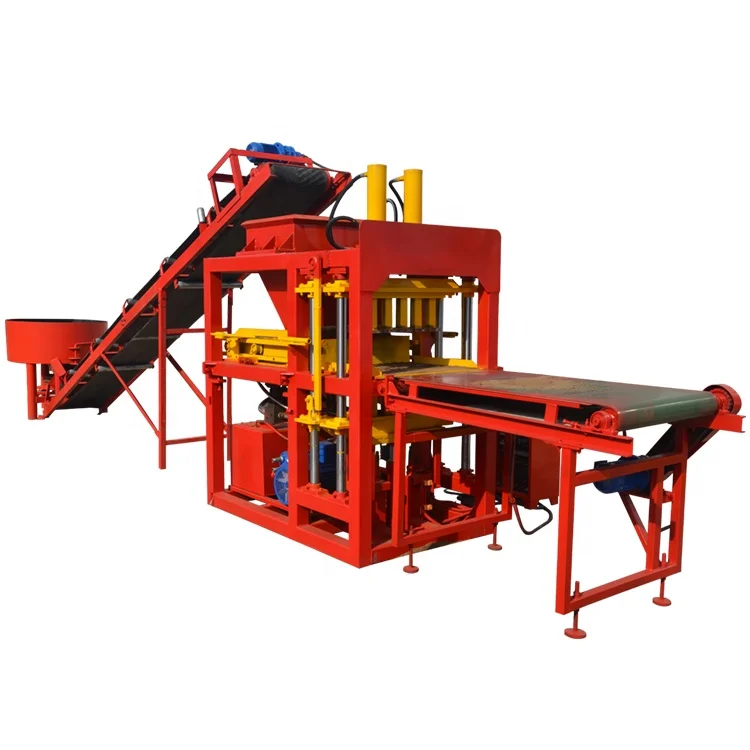
Matched System Approach — Every station from material feeding through curing is sized against the LY4-10 press cycle, so no single link bottlenecks the clay interlocking brick line.
Technical Specifications
| Parameter | Value |
|---|---|
| Model | LY4-10 |
| Product Type | Interlocking Clay Brick Making Machine |
| Rated Power | 11 kW |
| Hydraulic Pressure | 16 MPa |
| Molding Cycle | 10–15 s |
| Output Capacity | 1,440 pcs/h (based on 300×150×100 mm interlocking block, 4 pcs/mould) |
| Daily Output | 14,400 pcs/day (based on 300×150×100 mm interlocking block, 10 h operation) |
| Pcs per Mould | 4 (300×150×100 mm interlocking block) |
| Raw Materials | Laterite, yellow or red soil, sand, cement, water |
| Mix Ratio (Cement + Clay) | Water 3%, Cement 6–8%, Clay 80–90% |
| Mix Ratio (Full Clay) | Water 3%, Clay 90–95% |
| Machine Weight | 1,600 kg |
| Overall Dimensions | 2,260 × 1,500 × 2,380 mm |
| Workers Required | 1–2 |
| Automation Level | Automatic (material feeding, mould pressing, mould lifting) |
| Standards | CE, ISO 9001 |
Application Suitability
| Application | Material or Output |
|---|---|
| Interlocking brick production for building walls | Laterite and red soil blended with 6–8% cement |
| Ecological brick manufacturing | Full clay mix with 3% water, no cement |
| On-site construction block production | Locally sourced yellow soil and sand |
| Road paving and landscaping brick projects | Interlocking format 300×150×100 mm blocks |
| Housing development contractor plants | Site-excavated soil with minimal cement addition |
Why "14,400 Bricks a Day" Means Nothing Without the Rest of the Line
The press only produces when upstream mixing and downstream pallet handling match its 10–15 second cycle.
I once watched a clay interlocking brick making machine production line in Africa where the press sat idle nearly a third of the shift because the pan mixer could not discharge fast enough. The buyer had specified the press carefully but treated the mixer, pallet feeder, and stacking station as afterthoughts. Daily output dropped to a fraction of the quoted figure, and fresh bricks were stacked by hand on whatever flat surface was available [NEED_CITE: common line bottleneck causes in small brick plants]. This is the gap that a standalone press quotation leaves open — the interlocking clay brick making machine production line only performs when every station is timed against the press, not against catalogue defaults.
Station-to-Station Timing in the Clay Interlocking Brick Line
The LY4-10 completes a moulding stroke every 10–15 seconds, which means the mixer must deliver a consistent batch within that window and the pallet feeder must present a clean pallet before the press head lifts. When the interlocking clay brick making machine production line is laid out as a sequence of isolated purchases, the slowest station dictates real output. Specifying each station’s cycle against the press ensures the line runs as one mechanism rather than a collection of independent machines waiting on one another.
How the Press Integrates with Curing and Handling
Once the interlocking clay brick making machine production line produces a pallet of wet bricks, those bricks must move to a curing area without delay or damage. Pallet size and material must match the forklift the buyer already operates and the curing rack spacing on site. When pallets are undersized or the wrong material, bricks crack during transport, and the curing area fills unevenly [NEED_CITE: pallet material and curing environment effects on clay brick strength]. The line specification must include pallet handling, stacking, and curing rack dimensions — not just the press.
Reading the Numbers That Matter on the LY4-10
Hydraulic pressure at 16 MPa works with the vibration force to compress the clay-cement or full-clay mix into a dense interlocking block. If pressure is set without reference to the buyer’s local laterite or soil, blocks may emerge under-compressed or over-compacted, affecting interlocking fit and wall strength. The moulding cycle of 10–15 seconds determines the pace that all upstream and downstream stations must follow, making it the single most important figure in line design. The machine’s automatic cycle — material feeding, mould pressing, and mould lifting — reduces manual intervention, but only if the pallet feeder and mixer are equally reliable. Mix flexibility across laterite, red soil, yellow soil, and sand with cement ratios from 6–8% down to zero cement means the interlocking clay brick making machine production line can adapt to what the buyer can actually source locally.
When the Wrong Mixer Undoes a Good Press
A buyer who pairs the LY4-10 with an undersized mixer will see the press idle while waiting for the next batch, negating the automatic cycle advantage entirely. Similarly, if the pallet feeder jams or presents pallets at inconsistent intervals, every stoppage ripples through the entire shift. These are not theoretical failures — they show up as missing daily targets and operators standing around a machine that is technically capable but line-starved [NEED_CITE: production loss from mismatched line equipment]. The cost of correcting these mismatches after installation far exceeds specifying them correctly at the quotation stage.
Why Buyers Source the Full Line Here
Block machinery is our single focus, which means the LY4-10 press, its moulds, pallets, mixers, and handling stations are specified as one matched system rather than assembled from separate suppliers. Each line is configured against the buyer’s actual mix design, local aggregate, and target block format — not a catalogue default. Mould design covers the formats the buyer’s market actually sells, with custom drawings available when standard moulds do not fit. Automation levels are selectable, so a buyer can begin with semi-automatic pallet handling and add stacking and cubing later. Installation and commissioning include operator training so the line runs correctly from the first shift, and mould and wear parts support continues beyond delivery.
Documentation & Verification
- Line layout with capacity calculation stating the 300×150×100 mm block format assumed
- Machine specification sheet with hydraulic and electrical schematic
- Mould drawing and format list for interlocking block profiles
- Pallet specification matched to buyer’s curing rack and forklift
- Voltage, frequency, and control language confirmation before dispatch
- Factory test record and operation manual included with shipment
Installation, Commissioning & Support
- 11 kW power requirement verified against buyer’s site supply and dedicated circuit
- Machine footprint 2,260 × 1,500 mm checked against workshop floor space and headroom
- 1,600 kg weight confirmed for floor loading and forklift capacity on arrival
- Hydraulic pressure set to 16 MPa and moulding cycle tuned during on-site commissioning
- Automatic material feeding and mould lifting functions tested with operator present
- Wear parts and mould replacement schedule provided at handover
What We Need to Size Your Line Correctly
Tell us the clay or soil type available on your site and the cement percentage you plan to run. Share your target daily output, the block format your market demands, and the curing area dimensions you have planned. Let us know your local voltage and frequency, the control display language your operators read, and whether you already have a forklift and pallet racking in place.
Frequently Asked Questions
Q: How is the 14,400 pcs/day figure verified and for which block format?
A: That figure is based on the 300×150×100 mm interlocking block at four pieces per mould, running a 10–15 second cycle over a ten-hour shift. If you produce a different format, the daily output changes because the mould cavity count and cycle time shift. We state the assumed format in every capacity calculation so there is no ambiguity at the quotation stage.
Q: Which supporting stations come with the LY4-10 so the press is never waiting?
A: The line specification covers the mixer, pallet feeder, raw material feed system, and curing rack handling equipment. Each station is sized so its cycle matches the press stroke, preventing idle time. We confirm pallet size and material against your curing area and forklift before finalising the layout.
Q: How do cycle times at each station align to prevent bottlenecks?
A: The LY4-10 moulding cycle of 10–15 seconds sets the pace. The mixer must discharge a full batch within that window, the pallet feeder must present a pallet before the press head lifts, and the stacking station must clear the finished pallet before the next stroke. We calculate and confirm each station’s timing in the line layout document.
Q: What voltage, frequency, and control language are confirmed before dispatch?
A: We confirm all three before production begins. Voltage and frequency must match the buyer’s site supply to avoid transformer issues on arrival. The control display language is set to the operator’s working language so commissioning is not delayed by unreadable menus or error messages.
Q: How is the mix design matched to locally available laterite, soil, and sand?
A: The LY4-10 handles cement-clay mixes at 6–8% cement as well as full-clay mixes with no cement. We ask for a sample of the buyer’s local material and adjust the hydraulic pressure and cycle parameters to that specific soil composition, ensuring block strength and interlocking fit meet the project requirement.