
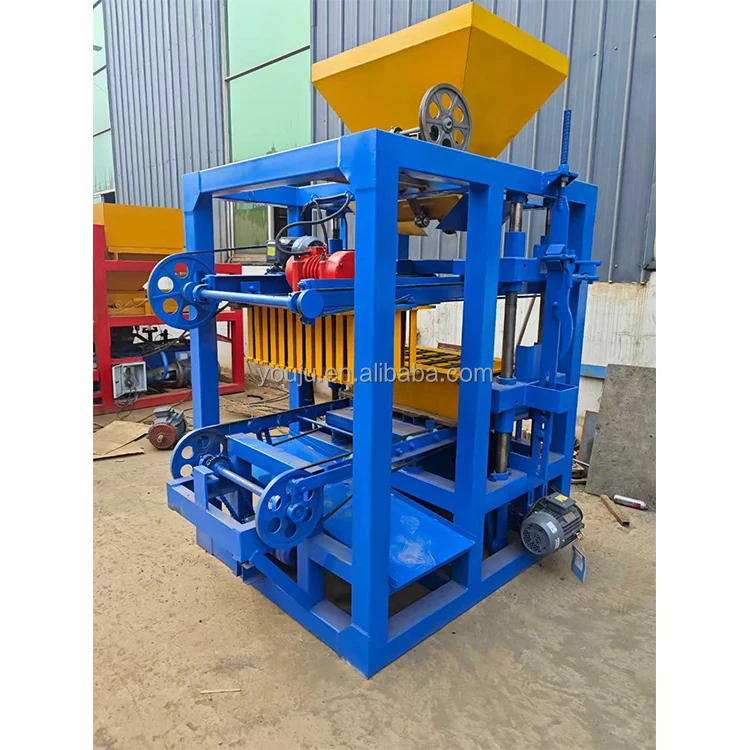
Integrated line engineering — Every station from mixer to stacker is specified as a matched system around the QTJ4-26 press, so cycle times align and the machine is never left idle waiting for material or pallets.
Technical Specifications
| Parameter | Value |
|---|---|
| Model | QTJ4-26 |
| Product Type | Semi-Automatic Concrete Block Making Machine |
| Overall Dimensions (Working State) | 3600 mm × 1700 mm × 2560 mm |
| Total Mass | 1750 kg |
| Overall Power | 14.25 kW |
| Molding Type | Platform Vibration |
| Pallet Size | 850 mm × 450 mm |
| Vibration System | Lower: dual 3 kW motors; Upper: 1.5 kW attached device |
| Frame Type | Dragon gate style, super steel, four vertical wear-resisting shafts |
| Elevating System | Cone-shape motor, JZQ250 speed reducer, V-belt drive |
| Delivery Device | Cycloidal pin wheel speed reducer, chains, self-conveying frame |
| Material Storing | Top releasing hopper + lower storing hopper |
| Control System | Electronic control (PLC or MCC configurable) |
| Standard Line Equipment | JQ350 pan mixer, 6 m belt conveyor, trolley |
| Optional Equipment | Auto stacker, block clamper, diesel generator, wheel loader, forklift |
| Voltage & Frequency | Configurable to site requirement, to be confirmed before production |
Application Suitability
| Application | Material or Output |
|---|---|
| Hollow block production | Crushed stone, river sand, cement blends for small-to-medium block plants |
| Solid brick manufacturing | Fly ash, quarry dust and cement mixes for masonry supply |
| On-site contractor production | Local aggregate and cement for housing and infrastructure projects |
| First plant entrepreneur setup | Standard concrete mixes for regional building material distribution |
Why the Quoted Capacity Number Rarely Matches Your First Month of Production
A cycle rate printed on a brochure means nothing unless it names the exact block format, mix design and pallet handling cadence it assumes.
When I walk onto a new plant and the owner tells me the output is half of what was promised, the press itself is rarely the problem. The mixer cannot keep up, the belt conveyor delivers material in surges, or the operator is still carrying pallets by hand while the machine sits idle between cycles. A semi-automatic block making machine production line only reaches its stated rhythm when every station — material feeding, pressing, pallet transport — is timed against the same block format. [NEED_CITE: common causes of block plant output shortfall]
Stations That Keep the Press Fed
The JQ350 pan mixer and 6 m belt conveyor ship as standard base equipment with this line, not as afterthoughts sourced separately. The mixer batch size and the conveyor speed are chosen so the material storing hopper on top of the QTJ4-26 frame stays replenished between cycles. When the hopper runs dry, the press completes a cycle with partial fill and the block density drops — a problem that only shows up once you count rejected pieces at the curing yard.
Where Pallet Handling Defines Real Daily Tonnage
The 850 mm × 450 mm pallet size dictates how many blocks leave the press per cycle and how they travel to the curing area. The standard trolley carries loaded pallets to the yard when stacking is manual. For buyers who want to reduce that labour, the optional auto stacker handles three to six layers per pallet height. Either way, the pallet specification must match the forklift and curing rack spacing you already have on site — a mismatch there creates a bottleneck no amount of press speed can fix. [NEED_CITE: pallet handling impact on block plant throughput]
Reading the Specs That Actually Shape Output
The dual 3 kW lower vibration motors and 1.5 kW upper vibration device work through the dragon gate frame and four vertical shafts to compact the mix from both directions. This platform vibration approach suits mixes with moderate cement content and local river sand, but the vibration parameters must be matched to the aggregate grading and moisture level at your site. The cycloidal pin wheel delivery device and self-conveying frame move the material releasing hopper into position between cycles, and any lag here directly extends the overall cycle time. The JZQ250 speed reducer on the elevating system controls mould head descent — consistent speed here means consistent block height across a full production run. Voltage and frequency must be confirmed before the control panel is wired, because a 50 Hz motor on a 60 Hz supply will run at the wrong speed and throw off every timing calculation in the line.
The Hidden Cost of Treating the Press as a Standalone Purchase
Buying the press alone and sourcing the mixer, conveyor and pallet equipment from different suppliers seems cheaper until commissioning day. The mixer output does not match the press appetite, the belt conveyor drops material outside the hopper opening, and the pallets you bought locally do not slide onto the press rails. Each of these mismatches costs weeks of adjustment and replacement parts. [NEED_CITE: risks of sourcing block line stations from separate suppliers] A semi-automatic block making machine production line specified as one system avoids these interface problems because every connection point — belt width to hopper mouth, pallet length to frame rails, stacker reach to curing rack height — is verified at the factory before shipment.
Why This Line Is Specified as a Single Matched System
The QTJ4-26 is never quoted here as a bare press. The mixer, belt conveyor, pallet handling and stacking options are selected together so the line cadence holds from raw material to cured block.
Capacity calculations state which block format the daily output assumes, so you can verify the number against your target product before placing the order.
Pallet size and material are cross-checked against your existing curing area dimensions and the forklift you already operate.
The automation level is selectable — you can start with manual pallet handling and trolley transport, then add the auto stacker as volume grows, without replacing the press.
Voltage, frequency and control language are confirmed during the order stage, preventing delays when the machine arrives and the electrician opens the panel.
Moulds for the formats your market actually buys are designed and supplied alongside the press, so the first production run uses the right tooling from day one.
Documentation & Verification
- Line layout drawing showing station spacing and material flow path for your block format
- Capacity calculation sheet stating the assumed block dimensions and cycle timing
- Pallet specification matched to your curing rack and forklift dimensions
- Voltage, frequency and control language confirmation record before wiring
- Factory test record on your specified mix and mould format before dispatch
- Packing photographs and customs documentation for smooth port clearance
Installation, Commissioning & Support
- Foundation plan based on the 3600 mm × 1700 mm footprint and 1750 kg mass for stable platform vibration
- Dedicated power circuit sized for the 14.25 kW total load including mixer and conveyor motors
- Assembly guidance for the dragon gate frame and four vertical shafts on first installation
- Vibration parameter tuning against your local aggregate sample during commissioning
- Operator training covering mould change, hopper refill cadence and pallet loading sequence
- Wear parts list for shafts, belts and vibration motor bearings with recommended reorder intervals
What We Need to Specify Your Line Correctly
Tell us the block formats you sell and the daily volume your market absorbs, along with a sample of the sand, stone or fly ash you plan to use. Share the dimensions of your curing yard and the forklift model on site so we can confirm pallet compatibility. Confirm your local voltage, frequency and the language your operators need on the control display.
Frequently Asked Questions
Q: How is the mixer output matched to the press cycle to prevent material starvation?
A: The JQ350 pan mixer batch size and the 6 m belt conveyor speed are calculated against the QTJ4-26 cycle time for your target block format. The material storing hopper acts as a buffer so the press always has a full charge ready. If your mix is sticky or slow to release, we adjust the hopper gate timing during commissioning.
Q: What equipment is included in the line quotation versus what is optional?
A: The standard scope covers the QTJ4-26 press, JQ350 pan mixer, 6 m belt conveyor and a trolley for pallet transport. The auto stacker, block clamper, diesel generator, wheel loader and forklift are optional add-ons. We quote each item separately so you can see exactly where your budget goes.
Q: How does the 850 × 450 mm pallet size affect my curing yard layout?
A: The pallet footprint determines rack spacing, stacking height and forklift tine width. We cross-check these dimensions against your existing curing area before confirming the order. If your yard uses a different pallet size, the press frame rails and delivery system can be reviewed for compatibility.
Q: Can the line start semi-automatic and add an auto stacker later?
A: Yes. The press and conveyor are identical in both configurations. The auto stacker bolts onto the exit side of the line when you are ready to add it, and the pallet discharge height is pre-set to accept the stacker frame without modifying the press.


