
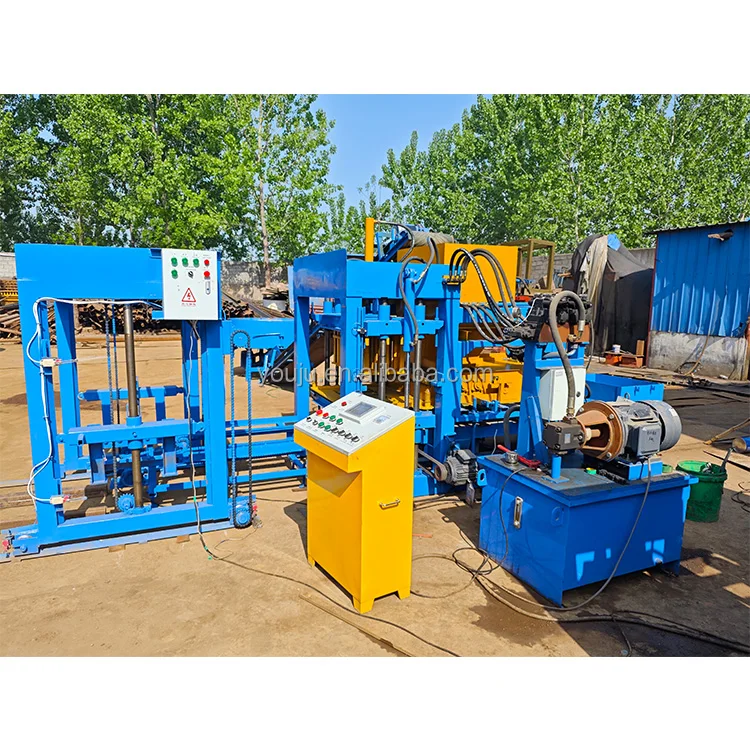
Integrated Line Planning — Every station from the JQ350 mixer to the pallet handling is timed against the 25-second host press cycle, preventing bottlenecks before they reach the site.
Technical Specifications
| Parameter | Value |
|---|---|
| Model | QTJ4-25 |
| Product Type | Semi-Automatic Concrete Block Making Machine |
| Rated Power | 17.9 kW |
| Overall Dimensions (L×W×H) | 6400 × 1500 × 2700 mm |
| Net Weight | 2500 kg |
| Molding Cycle | 25 s |
| Pallet Size | 850 × 550 × 20 mm |
| Vibration Frequency | 2800 r/min |
| Exciting Force | 60 kN |
| Output Capacity | 960 pcs/h, 7680 pcs/day (based on 400×200×200 mm hollow block, 4 pcs/mould) |
| Automation Level | Semi-automatic |
| Control System | Motor-driven (PLC presence not stated in source — confirm) |
| Hydraulic Station | Equipped (hydraulic pressure rating in MPa not stated in source) |
| Standard Configuration | Host machine 1 set, block mould 1 set, JQ350 mixer |
| Mould Compatibility | Hollow, solid, paver, curbstone (mould change required) |
| Assembly State | Stationary |
Application Suitability
| Application | Material or Output |
|---|---|
| Small to medium-scale block plant | Hollow blocks from crushed stone, sand and cement |
| On-site contractor production | Solid blocks using locally sourced aggregate |
| Paving block and curbstone supply | Concrete pavers and kerbstones via mould change |
| First plant for new entrepreneurs | Semi-automatic line from mixing to pallet handling |
What "960 Pieces per Hour" Leaves Out When Stations Are Not Balanced
A press rated at 960 pieces per hour (based on 400×200×200 mm hollow block, 4 pcs/mould) drops far below that figure if the mixer or pallet feed cannot keep pace.
I watched an Indonesian plant lose over a thousand blocks in a single shift because the upstream mixer ran out of batch while the operator waited for pallets to be manually slid into position. The host press sat idle, vibrating nothing but air. A semi-automatic block making machine production line only delivers its nameplate capacity when every station around the press is sized to the same 25-second cycle. That alignment is what separates a working line from an expensive bottleneck [NEED_CITE: industrial line balancing principles for concrete forming].
Matching the JQ350 Mixer to the Host Press Cycle
The JQ350 mixer supplied with the QTJ4-25 is selected so its batch volume and discharge time fit within the 25-second moulding window. If the mixer is too small, the press waits for the next batch; too large, and wet concrete sits in the hopper losing workability. In a semi-automatic block making machine production line, the mixer is not a standalone purchase — it is a station whose rhythm must lock into the press.
Pallet Size and Curing Yard Alignment
The 850 × 550 × 20 mm pallet is not an arbitrary choice. It must match the curing rack spacing and the forklift tine width already on site. I have visited plants where pallets arrived and the curing racks were built 30 mm too narrow, forcing the buyer to rebuild the entire yard. Confirming pallet dimensions against existing handling equipment is a step that belongs in the planning stage, not after the container arrives [NEED_CITE: pallet sizing and curing area logistics for block plants].
Vibration Force, Hydraulic Pressure and Block Density
The 60 kN exciting force combined with hydraulic compression and a vibration frequency of 2800 r/min determines how tightly the concrete matrix consolidates inside the mould. Bed mould vertical vibration and upper mould compression vibration work together during each 25-second cycle. When hydraulic pressure is set too low for the mix design, blocks emerge with weak cores; too high and the facing cracks. Both values must be adjusted against the buyer’s aggregate grading and cement ratio, not left at factory defaults.
The Hidden Cost of Ignoring Upstream and Downstream Timing
Quotations that list only the host press leave pallet feeding, block removal and stacking as manual afterthoughts. When an operator has to slide pallets in by hand and carry finished blocks to the curing area, the semi-automatic block making machine production line loses its cycle advantage. Downtime accumulates in seconds — a ten-second pallet delay per cycle translates into hundreds of lost blocks across a shift. Line-level planning catches these gaps before they become daily losses [NEED_CITE: common causes of throughput loss in semi-automatic block lines].
Why Source the Full Line from One Specification Point
Block machinery is the single manufacturing focus at Shandong Shiyue Intelligent Machinery Co., Ltd, so the host press, mould, pallet and mixer are specified as one matched system rather than assembled from unrelated suppliers. Configuration is set against the buyer’s actual mix design and local aggregate, not a catalogue default. Mould design covers the formats the buyer’s market sells, and the automation level is selectable so a plant can start semi-automatic and add stations later. Installation support and operator training address the full line, not just the press.
Documentation & Verification
- Line layout with capacity calculation stating 400×200×200 mm hollow block as the basis
- Machine specification sheet covering 17.9 kW rated power and 60 kN exciting force
- Mould drawing and format list for hollow, solid, paver and curbstone options
- Pallet specification confirming 850 × 550 × 20 mm against curing yard dimensions
- Voltage, frequency and control language confirmation sheet before production
- Factory test record on the buyer’s selected block format before dispatch
Installation, Commissioning & Support
- Foundation plan sized to the 6400 × 1500 mm footprint and 2500 kg static load
- Dedicated power circuit for the 17.9 kW rated draw with confirmed voltage and frequency
- Station-by-station commissioning verifying mixer-to-press and pallet feed timing
- Operator training covering mould change procedure across hollow, solid and paver formats
- Wear parts and mould list identifying first-replacement components by part number
- Maintenance schedule aligned to hydraulic station inspection and vibration assembly checks
Preparing a Line-Scope Inquiry
Share your target block format and the daily output you need so the capacity calculation reflects your actual product. Provide your local aggregate type and cement source so the mix design and vibration settings can be matched. Include your site voltage, frequency and preferred control language, plus the curing area dimensions and forklift specifications already in place.
Frequently Asked Questions
Q: How is daily output calculated, and which block format does the 7680 pcs/day figure assume?
A: The 7680 pieces per day figure is based on the 400×200×200 mm hollow block produced at 4 pieces per mould with a 25-second cycle. If you switch to a smaller solid block or paver, the pieces-per-mould count changes and the daily output must be recalculated for that specific format.
Q: What stations are included in the line, and where might cycle time mismatches cause the press to idle?
A: The standard scope covers the host press, JQ350 mixer and one block mould set with pallet feeding integrated. Mismatches occur when the mixer batch is too small to fill the hopper within the 25-second window, or when pallets are not staged fast enough between cycles.
Q: How should pallet size be matched to existing curing racks and forklifts?
A: The standard pallet is 850 × 550 × 20 mm. Before production, confirm your curing rack shelf width and forklift tine spacing accommodate these dimensions so that pallets move smoothly from press to yard without manual resizing.
Q: What voltage, frequency and control language need confirming before the machine enters production?
A: Provide your site supply voltage and frequency along with the preferred display language for the control panel. These details must be locked in before the electrical cabinet is wired, otherwise commissioning delays follow arrival on site.


