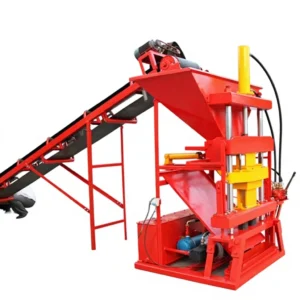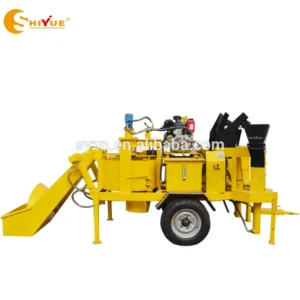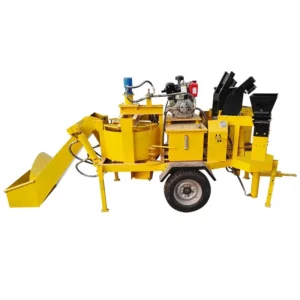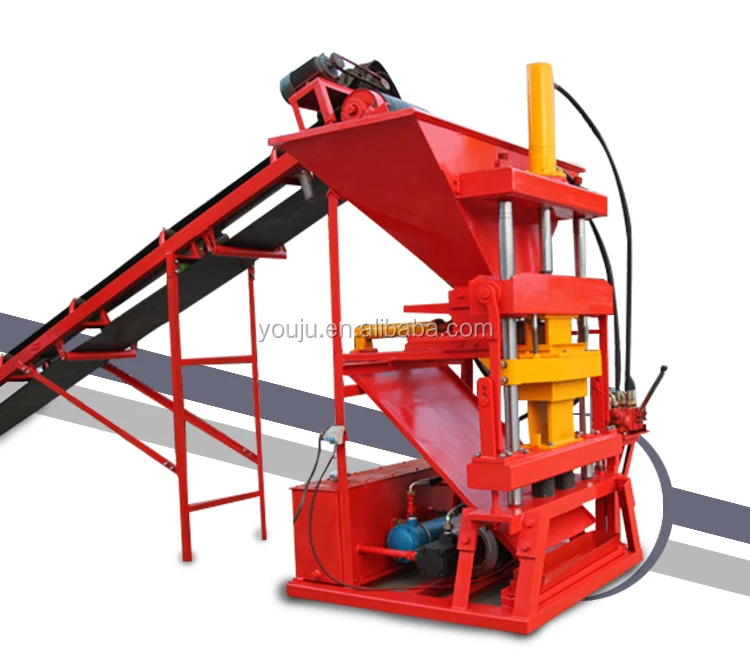
Single-focus line integration — the ECO2700 hydraulic clay press is specified together with mixer feed, pallet handling, and curing stations so no upstream or downstream station starves the forming cycle.
Technical Specifications
| Parameter | Value |
|---|---|
| Model | ECO2700 |
| Product Type | Hydraulic Clay Interlocking Block Making Machine |
| Overall Dimensions (L×W×H) | 1000 × 1000 × 1800 mm |
| Total Weight | 1000 KGS |
| Shaping Cycle | 15–20 seconds (basis to be confirmed with block format and material moisture) |
| Hydraulic Pressure | 16 MPa |
| Rated Power | 5.5 kW |
| Voltage & Frequency | 380V, 3-phase, 50Hz (configurable to local voltage) |
| Control System | PLC or manual control (to be confirmed at order) |
| Mould Format | Interlocking clay brick (dimensions to be specified per buyer drawing) |
| Pallet Size | To be matched with curing rack and forklift on site |
| Automation Level | Semi-automatic / manual operation |
| Warranty | 1 year |
Application Suitability
| Application | Material or Output |
|---|---|
| Small-scale interlocking brick plant | Local clay and mud with verified moisture content |
| On-site construction block production | Excavated soil from building foundation works |
| Community housing project supply | Clay blended with sand or crusher dust for green-strength stability |
| Format expansion for existing concrete block producers | Clay interlocking format added alongside current paver or hollow block output |
What a 15-Second Shaping Cycle Actually Means for Your Line
The press cycle is only as fast as the slowest station feeding or clearing it.
When buyers look at the ECO2700, the 15–20 second shaping cycle seems straightforward. But a clay interlocking block machine production line is a chain of synchronized stations. If the mixer cannot deliver a fresh batch every cycle, the press sits idle. If pallets are not returned from the curing area in time, the operator waits. I have walked into workshops where the press was rated for a certain tempo, yet the daily tally fell well short because pallet circulation was never calculated into the layout [NEED_CITE: pallet circulation rate versus press cycle in small block plants]. The real question is not what the press can do alone — it is what the entire clay interlocking block machine production line can sustain across a full shift.
Matching Mixer Output to the Press Tempo
The ECO2700 draws a fresh charge of clay mix every 15–20 seconds. A pan mixer or shaft mixer upstream must discharge a batch volume that matches this cadence. If the mixer takes longer than the press cycle to produce one batch, the operator stands idle and the clay interlocking block machine production line loses rhythm. We calculate mixer capacity against the press stroke volume and the specific gravity of your verified clay blend, then specify the mixer drum size and motor rating so the two stations stay in step.
Pallet Circulation and Curing Rack Synchronization
Interlocking clay bricks need time to gain enough green strength before they can be stacked or moved. The pallets carrying freshly pressed bricks must travel to the curing rack, sit for the required period, and return empty to the press feed point. If the curing rack holds too few pallets, the return loop breaks and the clay interlocking block machine production line stalls. We map the total pallet count against the curing duration and the physical distance between press and rack, then confirm the pallet dimensions fit both the ECO2700 feed table and the rack slots already on site [NEED_CITE: green-strength development time for hydraulic clay interlocking bricks].
Reading the Specs That Matter Beyond the Press
Hydraulic pressure at 16 MPa determines how densely the clay is compacted in the mould, which directly affects the green strength of the brick as it leaves the press. Higher density means the brick can survive the journey to the curing rack without edge damage, but it also means the curing rack must carry a heavier load per shelf. The 5.5 kW rated power of the ECO2700 is only one part of the total line draw — once you add the mixer motor, any conveyor drive, and pallet return mechanism, the main panel must be sized for the combined load with adequate headroom. The compact 1000 × 1000 mm footprint of the press allows a tight line layout, but minimum clearances for mould change access and pallet stacking lanes must still be maintained so operators are not working in cramped conditions. Voltage and frequency must be confirmed for every motor on the line, not just the press, otherwise a mixer rated for a different supply will fail at commissioning [NEED_CITE: three-phase voltage tolerance standards for industrial motors in export markets].
When One Station Drags the Whole Line Down
A line is only as reliable as its weakest link. If the pallet material warps under the moisture of wet clay, pallets jam in the return track and the press stops. If the control language on the PLC does not match the operator’s reading ability, settings drift and brick dimensions vary batch to batch. I have seen projects where the press arrived on time but the mixer was wired for a different voltage standard, delaying the entire clay interlocking block machine production line by weeks while a transformer was sourced locally [NEED_CITE: common causes of commissioning delays in exported block production lines]. These are not press failures — they are line integration failures, and they cost real time on a project deadline.
Why Sourcing the Line Together Changes the Outcome
Block machinery as a single focus means the ECO2700, its mould, the pallets, and the handling stations are specified as one matched system rather than assembled from separate suppliers who have never talked to each other. Configuration is set against your actual clay sample, tested in our workshop for moisture response and green strength, not pulled from a catalogue default. Mould design covers the interlocking profile your market actually builds with, including custom dimensions if your local standard differs from common formats. The automation level is selectable — you can start with manual pallet handling at the press and add automatic pallet feeding and stacking later without replacing the ECO2700 itself. Installation support covers the full line, so the technician who commissions the press also verifies that the mixer discharge height, pallet return slope, and curing rack alignment all work together.
Documentation & Verification
- Line layout drawing showing ECO2700 placement, mixer position, pallet return path, and curing rack area
- Capacity calculation stating the interlocking brick format and moisture content assumed
- Pallet specification matched to curing rack slot width and forklift tine spacing on site
- Hydraulic and electrical schematic covering press, mixer, and handling motors together
- Voltage and control language confirmation sheet signed before production begins
- Factory test record on buyer-supplied clay sample before dispatch
Installation, Commissioning & Support
- Foundation pad leveled to tolerance for the 1000 × 1000 mm ECO2700 footprint and 1000 KGS static load
- Dedicated circuit rated for combined line draw beyond the 5.5 kW press motor alone
- Press shipped semi-assembled with mould removed for container loading, reassembled on site
- First run uses buyer’s verified clay sample to confirm 16 MPa pressure produces acceptable green strength
- Operator training covers mould change procedure, PLC navigation in confirmed language, and daily greasing points
- Wear parts list covers hydraulic seals, mould liner plates, and pallet scrapers with reorder codes
Before You Request a Quote
To size the clay interlocking block machine production line correctly, we need your clay sample shipped to our workshop so we can verify moisture content and compaction response at 16 MPa. Share the interlocking brick dimensions your market requires, the curing space available on your site, and the forklift or pallet jack you already have so we can match pallet sizes. Confirm your site voltage, frequency, and the language your operators read so the control system is set before the line ships.
Frequently Asked Questions
Q: How do I confirm the mixer can keep up with the ECO2700 press cycle?
A: We calculate the batch volume the ECO2700 mould cavity requires per stroke, then match it against the mixer drum capacity and discharge time. The mixer must deliver one full batch within the 15–20 second shaping window so the press never waits. We state the assumed clay density in the line capacity document.
Q: What pallet size do I need for both the press and my existing curing racks?
A: Pallet length and width must clear the ECO2700 feed table and also slide into your curing rack slots with a small tolerance gap. We ask for your rack shelf dimensions and forklift tine spacing before specifying pallet material and thickness, so one pallet set serves the entire line without a second purchase.
Q: How is total line power calculated beyond the 5.5 kW press motor?
A: We add the rated power of the mixer motor, any conveyor drive, and the pallet return mechanism to the ECO2700 draw, then apply a starting-current factor for the largest motor. The result determines the main breaker rating and cable section for your site electrician, confirmed before production.
Q: Can the line start semi-automatic and add automation later?
A: Yes. The ECO2700 press can run with manual pallet handling at commissioning. Automatic pallet feeding and stacking stations can be bolted onto the line later without modifying the press frame or hydraulic circuit, so investment scales with your production volume.