
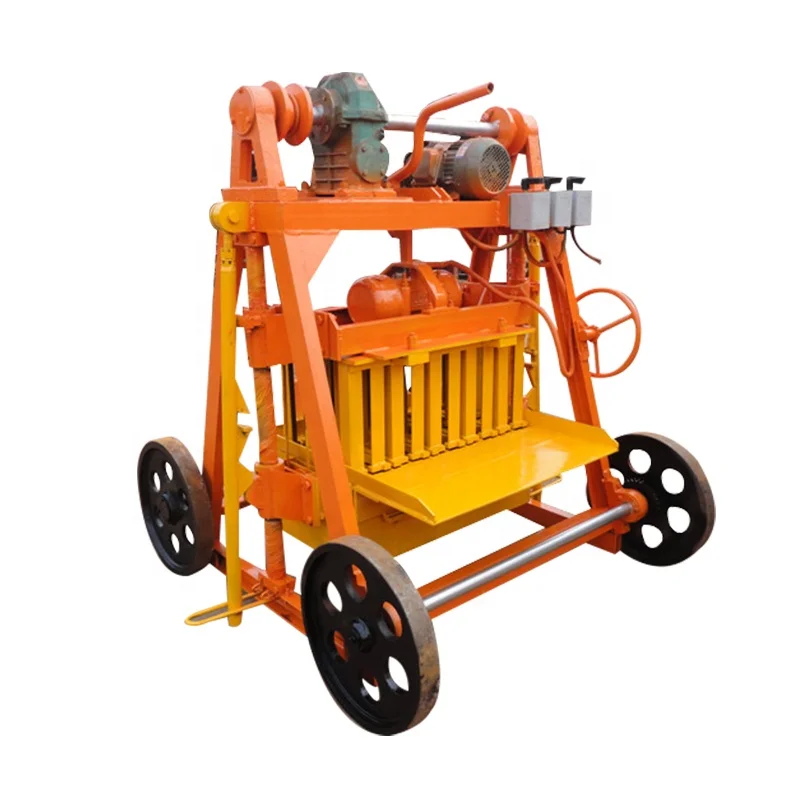
Matched Line Integration — The QMJ4-45 egg laying block machine is specified as a complete on-site production station, with mixer output and block-laying rhythm tuned to the same cycle so the press never waits for material.
Technical Specifications
| Parameter | Value |
|---|---|
| Model | QMJ4-45 |
| Product Type | Mobile Egg Laying Block Making Machine |
| Molding Capacity | 4 pcs/mould (400×200×200mm hollow block); 5 pcs/mould (400×150×200mm); 6 pcs/mould (400×120×200mm) |
| Molding Cycle | 40–45 s |
| Daily Output | 3000 pcs/day (based on 400×200×200mm hollow block, 8-hour shift); 3500 pcs/day (based on 400×150×200mm); 4500 pcs/day (based on 400×120×200mm) |
| Vibration Frequency | 2400 r/min |
| Vibration Method | Mold vibration (twice-vibration system) |
| Total Power | 6 kW |
| Power Source | Diesel / Petrol engine (motor option available) |
| Demold Method | Manual |
| Turning Method | Manual |
| Pallet Requirement | No pallets required (egg-laying on concrete floor) |
| Warranty | One year guarantee for the whole machine (source value — verify against manufacturer catalog) |
| Automation Level | Manual / egg-laying mobile operation |
Application Suitability
| Application | Material or Output |
|---|---|
| On-site hollow block production for building contractors | Cement, crushed stone, sand, and locally available aggregate |
| Small-scale block manufacturing without grid electricity | Diesel-driven hollow blocks in 200mm, 150mm, and 120mm widths |
| First block plant setup with minimal infrastructure | Hollow blocks produced directly on a prepared concrete floor |
| Remote or rural market supply by distributors | Mobile production of structural hollow blocks from regional raw materials |
Why "Output per Hour" Means Nothing Without the Block Format
Every capacity figure must name the exact block dimension it assumes, or it is just a number on a brochure.
I spent three days on a site in the Pearl River Delta re-timing a mixer-to-press handoff because the quoted cycle never matched real conditions. The contractor had been told a flat hourly number with no mention of block size, and when they switched from 200mm to 120mm hollow blocks the feeding rhythm fell apart. A mobile block machine production line only performs when each station — mixing, feeding, laying, curing — is calculated against a specific format [NEED_CITE: block production line cycle synchronization standards]. Without that, daily shortfalls accumulate silently.
How the Stations Connect Around the Press
The QMJ4-45 sits at the centre of a mobile block machine production line that has no pallet return conveyor, no curing rack system, and no stacker — because the egg laying block machine lays each block directly onto the ground. This simplifies the line dramatically, but it shifts the bottleneck upstream to mixing and feeding. The mixer must discharge a fresh batch within the 40–45 second molding cycle, and the operator must move the machine forward in step with that discharge.
Feeding Rhythm and the Floor Curing Layout
Since there is no pallet loop to buffer output, the curing area is the floor itself. A straight-line laying path must be planned so that freshly placed blocks are not driven over or disturbed by the next pass. The raw material feed point — typically a small hopper charged by a manual or mechanical mixer — needs to sit at one end of this path so that the operator never backtracks into wet blocks [NEED_CITE: on-site block curing area layout planning]. Getting this layout right before the first production day prevents avoidable breakage.
Vibration Force, Cycle Time, and Block Density
The twice-vibration system operates at 2400 r/min, delivering two vibration phases per mold fill rather than a single pass. For hollow blocks, this matters because the internal voids reduce the mass available to settle under gravity alone. The first vibration settles the mix into the mold corners, and the second compacts it around the core pins. The result is more uniform wall density across 200mm, 150mm, and 120mm formats. The 6 kW total power rating covers both the vibration motor and the travel mechanism, keeping energy demand within reach of a small diesel generator.
The Cost of Guessing Your Mixer Discharge Rate
When a mixer empties too slowly for the press cycle, the operator stands idle and the quoted daily output collapses. When it empties too fast, wet mix piles up and begins to set before the mold is ready. On a mobile egg laying block machine, there is no buffer conveyor to absorb either mismatch [NEED_CITE: mixer-to-press discharge synchronization in mobile block production]. The line stalls, the crew loses hours, and the contractor blames the machine rather than the system timing.
Why Source the Line as One Package
The press, mold set, and power unit are specified together so the vibration frequency and engine output match the mold format you will actually run. Mould drawings are provided for each hollow block width before production, not after arrival. Diesel and electric power options are confirmed against your site conditions during the quotation stage. The daily output calculation states the block format assumed, and the operation manual includes wear part schedules tied to actual cycle counts rather than generic intervals.
Documentation & Verification
- Line layout showing mixing station, feed path, and curing zone sized to the QMJ4-45 laying footprint
- Capacity calculation sheet stating block format for each daily output figure
- Mould drawing and format list covering 200mm, 150mm, and 120mm hollow blocks
- Power source confirmation document specifying diesel engine or electric motor rating
- Factory test record run on the buyer’s selected block format before dispatch
- Operation and maintenance manual with wear parts list and first-replacement schedule
Installation, Commissioning & Support
- Floor flatness tolerance verified before first lay to prevent block tilting on the QMJ4-45 ground-level mold release
- Diesel engine fuel consumption tested and confirmed against the 6 kW total power draw at commissioning
- Mould change procedure trained on-site so operators switch between 200mm and 120mm formats without extended downtime
- Vibration frequency checked at 2400 r/min under load to confirm twice-vibration performance with the buyer’s mix
- Wear parts inventory reviewed with the operator, covering mold liners and vibration mounts for the first replacement cycle
What to Include in Your Inquiry
Tell us the hollow block dimensions you plan to produce, the daily volume you need, and the raw materials available at your site. Confirm whether grid electricity is reliable or whether a diesel engine is required. Share your available floor space so we can map the laying path and curing area before quoting the complete mobile block machine production line.
Frequently Asked Questions
Q: How is daily output verified and what block format does each capacity figure assume?
A: Each output figure on the specification sheet names the exact block dimension and an eight-hour shift. For the QMJ4-45, that means 3000 pieces per day based on 400×200×200mm hollow blocks, 3500 based on 400×150×200mm, and 4500 based on 400×120×200mm. No single unqualified number is quoted without its format assumption.
Q: What site preparation is needed for the egg laying block machine?
A: A level concrete floor is required for block laying and curing. The floor must be flat enough to prevent mold tilt during release. A straight laying path should be planned so the machine advances without crossing over freshly placed blocks. Raw material storage and a mixing station are positioned at one end of this path.
Q: How does the egg-laying workflow connect with mixing and curing?
A: The mixer must discharge a batch within the 40–45 second molding cycle so the operator can refill the hopper and advance the machine without waiting. Cured blocks are left on the floor for the standard period before collection. The entire mobile block machine production line is a ground-level loop with no pallet return or rack system.
Q: Diesel engine or electric motor — which suits my site?
A: If grid power is unreliable or absent, the diesel or petrol engine option keeps production running independently. Where three-phase electricity is stable, the electric motor reduces fuel cost and noise. Power source selection is confirmed during quotation based on your site survey, not decided after delivery.
Q: What mould formats are available and how long does a change take?
A: The QMJ4-45 supports 200mm, 150mm, and 120mm hollow block widths with dedicated molds for each. Mould change is manual and involves lifting the mold box off the vibration table and seating the replacement. Operators are trained on-site during commissioning to complete the swap within a standard work break.


